
Polymer Chemistry
Customized polymeric dispersions for your product innovation
As part of an R&D polymer chemistry project in our laboratory facilities, we synthesize polymers with a defined property profile and jointly develop them as a typical project goal. Our scientists are experienced in free-radical, ring-opening and ionic polymerizations in solution, substance, emulsion and in suspension. In addition, polymer-analogous transformations and polymer functionalizations are often carried out to meet the specific needs of our customers. Since organic synthesis is one of our core competences, we can easily adjust monomers to add the desired functionalizations. With the help of a variety of analytical methods for polymer chemistry, we always ensure the monitoring of the reactions and quality control. Dedicated analytical equipment comprises spectroscopy (FT-IR, UV/Vis), gel permeation chromatography (GPC), differential scanning calorimetry (DSC), thermal gravimetric analysis (TGA), dynamic light scattering (DLS) and viscometry/rheology.
- Polar/hydrophilic
- Flame retardant
- Hydrophobic
- UV curing/photopolymers
- Antibacterial
- Specific barrier or membrane properties
Looking for a customized polymeric dispersion for your product development?
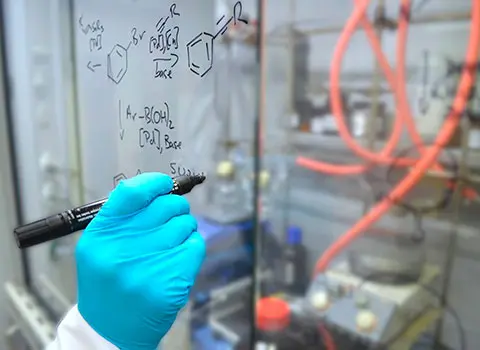
Synthetic Organic Chemistry
Custom Synthesis
As a leading Contract Research Organization in Europe, Taros provides valuable contract discovery for synthetic organic chemistry, chemical process development, and…
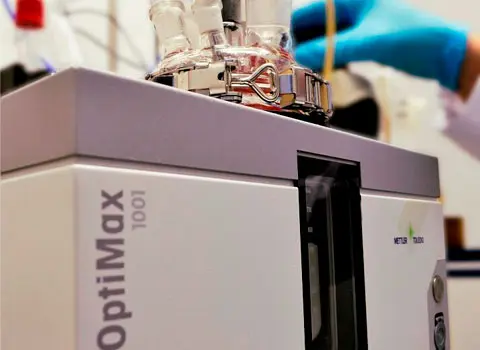
Process optimization and scale-up
Process Development
Making advantage of their expertise in organic chemistry and taking a design of experiments (DoE) approach to process development, our scientific teams in Germany…

Looks interesting?
As a leading CRO in Europe, Taros provides comprehensive drug discovery chemistry services for large Pharma and Biotech corporations as well as for Research Institutes and Academia
Our experienced chemists practice a pragmatic culture and customer-centric approach in order to exceed project expectations and, despite challenges, bridge very narrow timelines. They are trained to consider economic, safety and ecological boundaries and conditions laid out for all stages of the project.
Frequently Asked Questions
What polymer chemistry services does Taros provide?
Taros develops customised polymers and polymeric dispersions with defined property profiles for product-development and materials-science applications. Support can include polymer synthesis, monomer modification, polymer functionalisation, polymer-analogous transformations, reaction monitoring and analytical quality control.
Which polymerisation methods does Taros use?
Taros scientists have experience with free-radical, ring-opening and ionic polymerisation. These reactions can be performed in solution, bulk material, emulsion or suspension, depending on the monomers, desired polymer architecture, physical properties and intended application.
Which polymer properties can be customised and analysed?
Polymer projects can target properties such as hydrophilicity, hydrophobicity, flame resistance, UV curing, antibacterial behaviour and specific barrier or membrane performance. Taros uses methods including FT-IR, UV/VIS, GPC, DSC, TGA, dynamic light scattering and viscometry or rheology to monitor reactions and evaluate polymer quality.